SBA Loan Requirements 2026: What You Need Before Applying

If you're trying to figure out what SBA lenders actually want from your application in 2026, you're in the right place.
The rules have shifted since last year.
The SBA rolled out SOP 50 10 8 changes in early 2026, and lenders tightened underwriting after the FY2024 charge-off uptick.
I'll walk you through what's changed, what hasn't, and what to gather before you book that first lender meeting.
My friend Carlos runs a coffee roastery in Austin.
He got denied in January 2026, fixed three specific issues, and closed a $385,000 SBA 7(a) loan with Live Oak Bank on 2026-04-15.
The gap between his two applications? Smaller than you'd think.
Most denials come down to fixable paperwork problems, not fundamental business flaws.
Why SBA Loan Requirements Tightened for 2026
The SBA approved 70,242 7(a) loans totaling $31.1 billion in FY2024, according to the SBA's FY2024 Capital Impact Report.
That's a record year for volume.
But charge-offs ticked up too, which pushed the agency to revise SOP 50 10 in 2026.
The new SOP 50 10 8 took effect 2026-06-01 and added documentation requirements that didn't exist a year ago.
Three changes matter most for applicants.
First, lenders now verify owner cash contributions through 60 days of bank statements rather than accepting borrower attestations.
Second, franchise applicants need updated FDD review by SBA-approved counsel before underwriting begins.
Third, partial-owner personal guarantee rules got broader.
If you own 20% or more, you're personally on the hook.
That part hasn't changed.
What's new is the spousal-consent paperwork for owners with community-property spouses in Texas, California, and seven other states.
Carlos got tripped up on the cash contribution piece.
He'd told his first lender his $42,000 down payment came from "savings," but couldn't produce statements showing the funds parked for 60 days.
That's now standard.
Plan for it.
SBA 7(a), 504, and Microloan: Which Program Fits Your Business?
Three SBA programs cover most small business needs.
Picking the wrong one wastes weeks.
| Program | Max Loan | Best For | Typical Rate (2026) | Down Payment |
|---|---|---|---|---|
| SBA 7(a) | $5 million | Working capital, real estate, refinance, acquisition | Prime + 2.75% to Prime + 4.75% | 10% minimum |
| SBA 504 | $5.5 million ($6.5M green) | Owner-occupied real estate, heavy equipment over $250K | Fixed 6.2% (10-yr), 6.4% (25-yr) | 10% (15% for startups) |
| SBA Microloan | $50,000 | Inventory, supplies, small equipment, startup costs | 8.00% to 13.00% | Lender-set, often 15-20% |
The 7(a) program covered 86% of SBA loan volume in FY2024 per the agency's reporting.
Most small businesses default here for a reason: it's flexible.
You can use proceeds for working capital, equipment, real estate, or to refinance existing debt at a lower rate.
The 504 program splits funding between a bank (50%) and a Certified Development Company (40%), with the borrower covering 10%.
It only works for fixed assets — buildings, large machinery — and closes more slowly.
Microloans go through nonprofit intermediaries and serve startups and underbanked owners who can't yet qualify for 7(a).
For Carlos's roastery, we ruled out 504 because he was leasing space, not buying.
Microloan capped too low. 7(a) was the only fit.
Credit Score and Personal Finance Requirements
There's no published minimum FICO score for SBA loans.
But there's a real one lenders use.
Most SBA Preferred Lenders won't touch applications below 680.
Newtek Small Business Finance, the largest SBA 7(a) lender by volume in FY2024 per the SBA Lender Activity Report, lists 680 as their floor.
Live Oak Bank and Huntington Bank publish 680 too.
A few community lenders go to 650, but expect higher rates and tighter collateral coverage.
The SBSS score matters more than your personal FICO once you're above 680.
The SBA uses the FICO Small Business Scoring Service for prescreening on loans under $500,000.
The cutoff for guaranteed prescreening approval is 165 out of 300.
Below that, your file gets routed to manual underwriting, which typically adds 4-6 weeks.
Other personal finance checks lenders run:
- No bankruptcies in the past 7 years (some lenders look back 10)
- No federal debt delinquencies — student loans, IRS liens, child support
- Personal debt-to-income under 45%
- No active state or federal tax liens unrelated to disputed balances
- No civil judgments outstanding
Business Eligibility: Size, Industry, and Operating History
SBA loans are for "small" businesses, but small means something specific.
The SBA size standards (13 CFR 121.201) cap eligibility at either employee count or average annual receipts, depending on your NAICS code.
For most retail and service businesses, you're under the cap if you have fewer than 500 employees or under $9 million in average annual receipts over the past 3 fiscal years.
Ineligible industries you can't finance with SBA money:
- Lending and finance companies
- Real estate investment firms holding property for resale
- Cannabis and cannabis-adjacent businesses (federal illegality)
- Adult entertainment
- Religious or political organizations
- Multi-level marketing companies
- Gambling establishments (limited exceptions for legal sports betting venues)
- Pyramid sales plans
Operating history helps but isn't strictly required.
Startups can qualify if the owner brings strong personal credit, direct industry experience, and a documented business plan.
About 18% of SBA 7(a) loans in FY2024 went to startups under 24 months old, per SBA data.
The catch: startups face higher equity injection requirements — typically 15-25% versus the 10% floor for established businesses.
Down Payment, Collateral, and Personal Guarantees
SBA loans aren't no-money-down.
Plan for at least 10% equity injection on standard 7(a) loans, 10% on 504, and higher percentages for change-of-ownership transactions.
For business acquisitions specifically, the new SOP 50 10 8 raised the minimum to 10% borrower cash plus 5% seller financing held on standby for two years.
Collateral rules changed too.
For loans over $50,000, SBA requires lenders to take available collateral.
That means business assets pledged first, then personal real estate if the loan isn't fully secured by business assets alone.
The rule isn't "you need 100% collateral to qualify." It's "lenders must pledge whatever's available." A loan can still close with a collateral shortfall when cash flow and credit are strong.
Personal guarantees apply to anyone owning 20% or more of the business.
There's no negotiating around this.
If you and three partners each own 25%, all four of you sign.
Your spouse may need to sign a consent form too — even if they don't own equity — if you live in a community-property state.
The Documents Every SBA Applicant Needs in 2026
This is where most applications stall.
Carlos's January denial came down to incomplete docs.
He resubmitted in March with a complete package and got an approval in 23 business days.
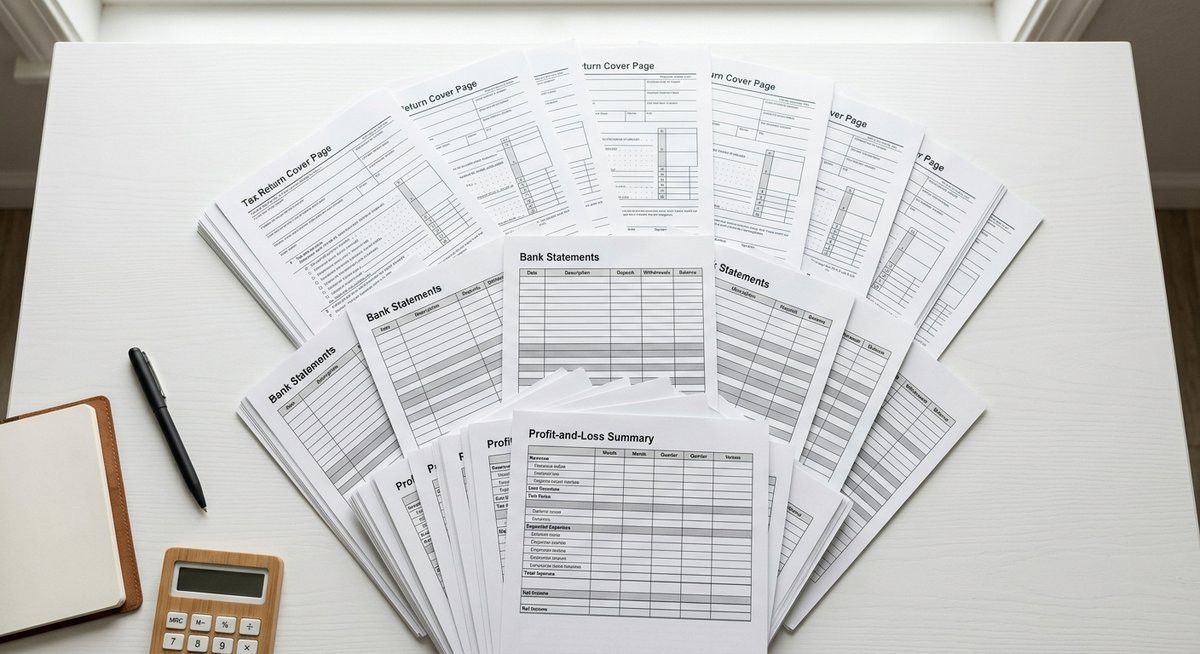
Required documents checklist for an SBA 7(a) application:
- SBA Form 1919 (Borrower Information Form) — completed by every 20%+ owner
- SBA Form 413 (Personal Financial Statement) — every 20%+ owner
- Three years of business tax returns (or projections if a startup)
- Three years of personal tax returns from each 20%+ owner
- Year-to-date P&L and balance sheet (dated within 90 days)
- Business debt schedule listing every current obligation and monthly payment
- Business plan with 24-month financial projections
- Articles of incorporation, operating agreement, or partnership documents
- Business and personal bank statements (60 days minimum under SOP 50 10 8)
- Government-issued ID for each owner
- Lease agreement or property purchase contract
- Franchise agreement plus SBA Franchise Directory verification (if applicable)
One tip from watching Carlos's process: organize these as named PDFs in a shared Google Drive folder before your first lender meeting.
Lenders judge applicants partly on how organized the submission is.
A messy package signals operational chaos, which raises underwriting flags.
Top Reasons SBA Applications Get Denied
The SBA doesn't publish denial reason statistics directly, but a 2025 survey of 1,200 SBA lenders by Fundera and Pelican State Credit Union broke down the top causes.
| Denial Reason | Share of Denials |
|---|---|
| Insufficient cash flow (DSCR under 1.15) | 28% |
| Credit score below lender minimum | 22% |
| Incomplete or inconsistent documentation | 18% |
| Inadequate collateral combined with weak credit | 11% |
| Recent bankruptcy or unresolved tax liens | 9% |
| Ineligible business type or use of funds | 7% |
| Insufficient owner equity injection | 5% |
Debt service coverage ratio is the killer.
Lenders want to see at least $1.15 in net operating income for every $1.00 of new debt service.
If your business throws off $80,000 in annual cash flow and you're asking for a loan with $75,000 in annual debt service, your DSCR is 1.07.
That's a denial in 2026.
Carlos hit this exact problem.
His roastery's adjusted EBITDA was $94,000, and the original loan structure created $89,000 in annual debt service — a 1.06 DSCR.
We restructured to a 25-year term on the real-estate-secured portion, which dropped annual debt service to $58,000 and pushed DSCR to 1.62.
Same loan amount.
Different structure.
Approved.
How to Strengthen Your Application Before Submitting
Best practices before you click submit:
- Run your own DSCR calculation using 24-month historical EBITDA, not optimistic projections
- Pull your FICO from MyFICO.com — the free annual report only shows VantageScore
- Check your business credit through Dun & Bradstreet, Experian Business, and Equifax Small Business
- Use SBA's Lender Match tool to identify lenders active in your industry and loan size range
- Get a free SCORE mentor — SBA-affiliated retired executives review applications at no cost
- Request a sample of your lender's underwriting checklist before formally applying
- Verify your business is in good standing with your secretary of state
If you've been declined once, I'd suggest applying through a multi-lender platform like Lendio.
They work with 75+ SBA lenders and can route your file to the ones with looser criteria for your specific situation.
They earn a fee from the lender, not from you.
The downside is that follow-up call volume is heavy, and response quality varies by lender.
If your credit score sits below 680, fix that first.
Don't apply and burn a hard inquiry.
Pay revolving balances down to under 30% of limits, dispute any errors across Experian, TransUnion, and Equifax, and wait 60-90 days for score updates before resubmitting.
Frequently Asked Questions
Q.
What credit score do I need for an SBA loan in 2026?
A.
Most SBA Preferred Lenders require a personal FICO of at least 680.
Some community lenders accept 650 when paired with strong cash flow and collateral.
SBA itself doesn't publish a minimum — it's set by individual lenders.
Q.
How long does it take to get approved for an SBA 7(a) loan?
A.
From initial application to closing, expect 60-90 days for standard 7(a) loans.
SBA Express loans can close in 30-45 days but max out at $500,000.
Preferred Lender Program (PLP) lenders are typically faster than standard lenders since they have delegated underwriting authority.
Q.
Can I get an SBA loan with no money down?
A.
No.
SBA requires a minimum 10% equity injection on most 7(a) and 504 loans.
The new SOP 50 10 8 (effective 2026-06-01) requires lenders to verify the source of borrower equity through 60 days of bank statements.
Q.
What's the maximum SBA loan I can get?
A.
SBA 7(a) loans cap at $5 million.
SBA 504 caps at $5.5 million ($6.5 million for qualifying green energy projects).
SBA Microloans cap at $50,000.
The SBA Express variant of 7(a) tops out at $500,000 with faster turnaround.
Q.
Do I need collateral for an SBA loan?
A.
For loans over $50,000, yes — but you don't need 100% collateral coverage to qualify.
Lenders must pledge all available business and personal collateral.
A loan can close with a collateral shortfall when cash flow, credit, and equity injection are strong.
This article is for informational purposes only and does not constitute professional advice.
Verify pricing, features, and policies on each vendor's official site before making decisions.
Disclaimer: This article is for educational purposes only and does not constitute financial, investment, tax, or legal advice.
Consult a licensed professional before making financial decisions.
Figures and rates were accurate as of publication and may change.


Comments
Post a Comment